Showing posts with label Finance and Economics. Show all posts

Sunday, February 15, 2009

Buffett's Buy Metric


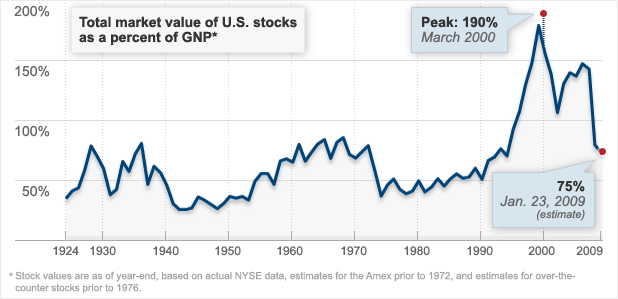
...Fortune first ran a version of this chart in late 2001 (see "Warren Buffett on the stock market"). Stocks had by that time retreated sharply from the manic levels of the Internet bubble. But they were still very high, with stock values at 133% of GNP. That level certainly did not suggest to Buffett that it was time to buy stocks.

But he visualized a moment when purchases might make sense, saying, "If the percentage relationship falls to the 70% to 80% area, buying stocks is likely to work very well for you."...

See the complete article here.

Saturday, February 14, 2009

On Globalization

Ran across this during my reading:
Where one nation has got the start of another in trade, 'tis very difficult for the latter to regain the ground it has lost; because of the superior industry and skill of the former, and the greater stocks which its merchants are possest of, and which enable them to trade for so much smaller profits. But these advantages are compensated, in some measure, by the low prices of labour in every nation that has not an extensive commerce, and does not very much abound in gold and silver. Manufactures, therefore, gradually shift their places, leaving those countries and provinces, which they have already enriched, and flying to others, whither they are allured by the cheapness of provisions and labour, till they have enriched these also, and are again banished by the same causes. And in general we may observe, that the dearness of every thing, from plenty of money, is a disadvantage, that attends an established commerce, and sets bounds to it in every country, by enabling the poorer states to undersell the richer in all foreign markets.

-David Hume, Of Money- 1752

It's all just a little bit of history repeating!

Saturday, October 11, 2008

It Is Time to Buy Back Into Stocks

I have long advocated a cautious stance within the current investment universe. Stock prices did not properly reflect the existence of unsustainable practices and imbalances in the economy. But now, stocks are down sharply from their peaks, and the people who were touting stocks last year have been replaced by a new league of doomsayers. The fear is that companies and fixed assets will be useless after a systemic financial collapse, and stock prices now actually reflect this fear.
Well, I don't buy into the logic, and I am buying heavily into stocks instead. Simple economic knowledge will suffice. Economics is after all the study of labor. Every year, laborers work, build, and gather resources to create the national product.

Now every year in a closed system, it would be nearly impossible to consume more than you produce. Why? Because in order to do that, you would have to be able to liquidate capital (accumulated labor) in order to consume more today. And frankly, I can't think of many assets that can be liquidated and then turned into immediate consumption, and I don't think anyone can give an example of that happening on a large scale. You don't look at a factory from the potential to boil it down and consume its steel somewhere else. That is highly nonsensical for almost any kind of investment.

Rather, the general sense is that every year, you have a level of production. Most of that is consumed, and then some amount of labor goes to capital accumulation- building investments for the future. The general trend is that labor is accumulating in the world in the form of capital, meaning that every year people have more fixed assets to deal with and so can become more productive and consume more, as times goes on.

What could break this trend? I've identified three things.
-One I mentioned just previously- if the economy liquidated capital for present consumption. That is relatively hard to do for reasons explained.
-The second would be a temporary inefficient allocation of capital and labor. (Say for example, building a large call center and hiring a bunch of people to recklessly lend money. Or, massively over-investing in telecom and internet technology). These can not last too long because eventually reality hits and the bad investments cease to be profitable.
-Third would be imbalances between the units of the economy. For example, if the rich take too large a share of the value of production, then 1) workers won't have enough money to consume what is produced, and 2) the rich will have too much money and have nothing better to do with it then say... lend it recklessly for people to spend. Although this would be labeled investment, in reality is the finance of another's consumption. And that is a shaky investment proposition.

Both two and three have occurred, both in the global scene and the US. The rich have become to rich. And an entire infrastructure has subsequently been built around lending that money out recklessly. I find this chart to be no mere coincidence.


Yet it is important to keep these matters in perspective. There is potential for some loss of growth, but how much? I'll analyze the three risks from the standpoint of the US.

1) Consuming More than Production- unfortunately, the US is not a closed system. Every year, we import more than we export to the tune of 5% of GDP. Although it is not encouraging, it is tough to worry too much about it. After all, we are investing at the same time at over 20% of GDP. And total foreign debt amounts to 5 trillion, or maybe 250 billion in interest payments a year- That is definitely manageable in a 13 trillion annual economy.

2) Liquidating Inefficiencies- The financial sector was a bubble. An entire infrastructure was built around lending money recklessly and booking massive fake profits. At one point, financial profits made up 40% of S&P earnings. Yet still, this is also manageable. Finance as a whole employed 7 million people, or about 6% of the population. Some of that was wasteful, but many of those jobs are necessary. And most of the grossly reckless practices of the bubble days have now ceased to exist.
Meanwhile, it is hard to convince me that investments made in other sectors were bubbles as well. After all, the mere fact that people would choose to consume them given enough money is proof enough that given a little more income, these jobs and these investments would be profitable again. Rather, it points to the imbalance in the distribution of wealth, which embodies the next point.

3) System Imbalances- This touches at the heart of the problem, and it will also be the hardest to fix. There exists an imbalance between investment and consumption in the economy, with there being too much of the former. As you accumulate too much investment, the potential returns diminish; they can even be money losing propositions. Well, that appears to be exactly what is happening today, as large concentrations of wealth (what Keynes would call sink funds) have invested too much money, recklessly, in the financial sector (one of the easiest sectors to do that in). Think of economic actors such as China. Now, the correction must take effect. In a simpler world, the process would balance itself. They would invest recklessly, the returns on projects would be negative, they would lose wealth at the expense of their workers and their customers, and then things would return to a more correct level and the process would continue from there. Unfortunately, the real world is not so lucky. As this starts to happen, they panic. They throw all logic out the window and flee into anything that will protect their wealth- either cash or treasury bonds. Look at yields on short term treasuries today and they are barely half a percent annually. This has begun.

The good news is this is correctable. If the economy was producing at this level before, it can be maintained with a more equitable distribution of investment and consumption. What you need to do is let investors take losses, but also have government step in wherever it can to ensure confidence. Today, there are several things we must see. We need government to step in and invest in the financial sector, in return for equity participation in a brighter future. We need losses to be taken in stocks and bonds to correct imbalances, but we also need confidence restored for investing in the business. The government should take on debt to promote investment, taking advantage of the extremely low yields which they can now borrow at. Finally, it should tax the lower class less and tax the rich more to correct the current imbalances. Largely, this appears to me to be what the government has been doing.

So where does that leave you, the individual investor? Well today, stocks represent a huge discount to any type of scenario in which the world economy exists 5, 10 years from now. Yes, the rate of return on capital has been inflated, meaning recent profits are likely a bad representation of reality. But global growth will continue, and earnings will return one day. In the meantime, an investor today doesn't face much competition in terms of yield. For the first time in several decades, stock dividends now offer a higher yield than treasuries (whose yields have plummeted), and that is a major buying signal. Many companies are trading below any type of value based on replacement cost, or on earnings power in a normalized environment. An investor who can identify businesses which:
1) provide real value,
2) which will be around for the next 50 years,
3) have some forms of competitive advantages, and
4) are prudently financed

will find the prices on stocks today to be very attractive. Stock investors with long term time horizons will find significant bargains and returns in purchasing at today's stock levels.
Monday, September 08, 2008

The Fannie/Freddie Bailout, And Lessons To Be Learned

The government yesterday announced their plans for supporting the continued functioning of Fannie Mae and Freddie Mac(The "GSEs"). The specific details of the plan can be found here, but essentially it boils down to the government stepping in and backing GSE debt obligations with the full faith of the U.S. government, thus ensuring their full principal value. What does this mean, who gets affected, and why was this necessary? These are all questions I'll try to briefly answer.

The GSE's are massive organizations which were created with the intent of promoting homeownership and adding liquidity into the marketplace. The organizations were mostly involved in two lines of business. First, they operated as guarantors in the mortgage market. Banks could sell mortgage loans qualifying under certain criteria to the GSE's. They would then package them into securities, guarantee them, and take a portion of the interest payments as a fee in return for the guarantee. The second line of business involved issuing large amounts of debt (for cheap) and then using that money to purchase mortgage loans which gave a higher interest rate and had historically performed well.

But history is a bad measure, and the institutions were hit from multiple angles. They ended up under-pricing the risk of their mortgage guarantee business, and the mortgages they purchased with debt began to decline significantly in value. These combined to completely wipe out equity, at least if you were looking at their equity from a "fair value" basis. (The company for several quarters has insisted on using its own projections to value its assets/liabilities over the market's pricing, but they provided both figures.) That lead to the questioning of their viability, and the cost to issue debt for the institutions began to rise sharply. That began to add even more devastation to their second line of business, because they could no longer fund their mortgage assets with cheap debt. It would have only been a matter of time before the companies went into bankruptcy.

Now, the government has stepped in and essentially gauranteed full value for the debt issued by Fannie/Freddie, as well as their obligations for guaranteed mortgage securities. Those combine to total over 5 trillion. Those are backed by mortgage assets, and the first losses will accrue to common and preferred shareholders. Still, that is little comfort to me, as by fair value measures these institutions have been equity-negative, and I perceive things to continue to worsen for some time. Their will ultimately be big losses for government. That means taxpayers will be suffering for the benefit of the investors in mortgage assets.

That is a redistribution I would prefer without. And there is one more negative hazard to this deal as well, but these are completely over-shadowed by the systemic necessity of the deal. But first, that negative is that government has now taken over the judgment of future mortgage risk. It makes me shudder to think that we have offloaded the task of judging risk from hundreds of thousands of banks to one central institution (although we got into this mess because there was a complete lack of risk judging by banks, in the first place). Instead, everything will now dance to the tune of the GSE guidelines. The government has committed to wind down the GSE business over time and diminish its role in the mortgage market, but that will be a long time.

Unfortunately, the move was very, very necessary. If the GSE's were to announce bankruptcy, I believe you'd have a terrible hellish limbo (and please correct me in the comments if im wrong on this point). Unlike typical bankruptcies, nothing for the GSE's could function as usual. As I understand it, they could not pay off expiring debt, and they could not pay off guarantee obligations- simply, they couldn't do anything. That is because once in bankruptcy, their debt obligations would disregard time duration and instead put them on equal footing based on their class (senior, junior, etc). That means, a senior note expiring and scheduled to be paid back in 30 years would have the same value and rights as a senior note due tomorrow. That means the institution could not pay back anyone until it figured out what it could ultimately pay back. Well in the case of the GSE's, that could be ages. I mean, their assets are long duration mortgages to individuals which can't be redeemed, meaning you'd have to wait for them to slowly get paid back. And some of their guarantee liabilities extend for 10 years or more, and can change rapidly at any time depending on the mortgage market situation. Best case, you'd have to wait until the mortgage situation clears up and you find suitable buyers of its tremendous load of assets and guarantees. But considering the size of the liability, that is very unlikely for everyone except government.

And in the meantime, you have stagnation. The company would have to preserve all its capital and pay out nothing. That means that thousands of institutions around the world would be holding pieces of paper paying them no interest, with questionable ultimate value, and no idea of when any of that value may ultimately be able to be realized. Things would shutdown, people would be furious, and foreign lending to the US would cease. That could not happen, and sadly, that means the institutions could not be allowed to fail.

What can we learn from this saga? Well, the situation does not bode well for other mega-banks on shaky financial footing, especially those with long-duration credit default swaps. If one of these institutions were too fail, the same thing would happen here- everything would freeze up until ultimate liabilities can be determined, leaving a very large class of debt and CDS holders in stagnation for a long period of time. "Doomsday" would then ensue.

Friday, April 25, 2008

21st Century Economics

The best way I can explain the global economy today is from the perspective of the following equation:

Value of Production = Labor + Knowledge + Materials + Investment + Power

Now, remember the value is allocated across these factors based on the basic rules of competition. In that sense, the United States (and the developed world) has long had an advantage in three factors: Knowledge, Investment, and Power (think global brands or other forms of market power). And this advantage allowed them to bring relatively more value and wealth to their countries. Company X could invest in developing country Y. They could pay there employees next to nothing, and then send both the goods and the profits back to the home country. This wealth would then be dispersed throughout the population.

Everyone knows that globalization has greatly increased the working population, driving down the value of pure labor. (Supply goes up, returns go down) But other factors have also come into play. These workers have seen the developed world's living standards, and they see all the goods which they are producing, and they decide that they want these things too. And more importantly, they are acquiring the ability to do so without the developed world. First, they have developed modern financial systems, so they have the ability to raise capital and finance large investments on their own. Second, they are rapidly acquiring expertise and knowledge from us. Finally, their power over in the global economy is rising. As the competitive advantages start to deteriorate, then more competition takes place- and production can go up.

This sounds great for long term growth because the rest of the world is raising their living standards. The problem is there is now a new bottleneck. Demand for production has increased significantly, but the supply of materials remains static. So now there is a new advantage from the control over scarce materials. This is why we are seeing such large increases in basic goods- food, energy, raw materials, etc. In the short term, things seem surely to become more difficult and costly. But long-term optimists can take comfort that the solutions to these problems are going to have to come from scientific and technological progress (Or war... see post). And in that sense, the developed world still has a very large advantage in terms of the possession and acquisition of knowledge.


Feel free to critique.

Wednesday, March 19, 2008

Characteristics of Equity and Debt

I thought that in the wake of the current financial mess, it would be a good time to go over an important difference between equity and debt investing.

Every company faces the choice to finance their business/ expansion plans with equity capital or debt capital. First, let us start with equity investing. There is a clear and pretty well accepted definition for the value of issued shares to investors- it is the discounted future cash flow of your share in the business. It is much more difficult in practice, and most people's guesses are as good as anybodies. For the company however, all that matters is that initial issuance price. Regardless of what the true value of their issued shares are, the amount of money the company raises is equal to the initial share price multiplied by the number of shares issued. These shares can never be "put back" to the company.

Afterwards, investors deal only amongst themselves. If I, as an investor, am able to perfectly calculate the value of a company's share and purchase it for less than that price, I would be value investing. In the short term, their value is reliant on what "Mr. Market" is willing to offer me on that day. But the good thing about stock investing is that I have no deadline on which I am forced to sell my shares. So if I had no time restraints, I could just hold on to those shares and watch as the company generates the cash flow (which I had perfectly predicted). At some point, the market will either recognize this or investors will demand the company dividend this money to them, allowing me to recognize fair value for my shares.

But when dealing with debt investing, the situation is usually very different. The reason is because debt matures and principal must be paid back. Let us say that once again, I can perfectly predict the future cash flow of a certain business. This time though, the business is financed with debt which initially matures in five years. For the first five years, everything goes as planned. The company pays its interest, and even uses its excess cash flow to start repaying its debt. Still, at the end of five years, the company has a large portion of its principal remaining unpaid.

The company now has no choice- it needs to refinance to pay back its existing debtholders, and its ability to do so relies completely on the market's risk perception at the time. With stocks, this wasn't the case: an investor could just hold on to his shares into the future, and the share price would eventually represent its fair value. But as a holder of debt, an investor is now exposed to the danger that the market might not want to refinance the company's debt at a fair cost, if at all. And although I know the company's future cash flow justifies refinancing, I, in all likelihood, can not afford to refinance all the debt myself. The business can now be forced into bankruptcy, and a perfectly viable business can be forced into liquidation. The only way a debt investor can completely avoid this risk exposure is to make sure that the business' income can cover both its interest and its principal payments as they come due, but this type of conservatism is rarely seen.

To make matters worse, the great business rarely even bothers with debt. The Coca Cola's of the world have the most predictable and stable businesses, and the lenders feel the most comfortable lending to them. Yet, these companies also never need to leverage themselves because they have strong competitive advantages and are already earning great returns on their investment. It is usually the bad businesses which resort to debt in order to boost their profitability. And the worst businesses need to leverage themselves to the moon just to earn a decent return. The current financial crisis is fraught with just those types of situations. What happened to Carlye Capital, which collapsed earlier this month? (link)
In a short news release issued early Friday, the fund, which is managed by a unit of Washington, D.C., private-equity firm Carlyle Group, said it received "substantial additional margin calls and additional default notices from its lenders" and that "these additional margin calls and increased collateral requirements could quickly deplete its liquidity and impair its capital."
...
Carlyle Capital managed only $670 million in client money, but used borrowing to boost its portfolio of bonds to $21.7 billion, meaning it was about 32 times leveraged.
What Carlyle did was borrow at X% and invest in securities making (X+.50)%. The only way to make the returns on investment in that semi-attractive was, well... 32 times leverage. And what happened? The market got nervous and they decided not to refinance. The same thing is causing problems for SIV's, hedge funds, and financial institutions in general. Some of these companies may have done all of their work correctly (unlikely), but making the market confident of that is not so easy. After all, if a company like Carlyle was only 3% off, its entire equity would be wiped out and losses would start accruing to its debtholders. These financial firms are starting to realize that when dealing with debt, it is not just what you think that counts. And a 3%, 5%, or even 10% margin of safety is not very reassuring to investors after the housing bubble we have just witnessed.

Thursday, February 07, 2008

Predictions '08

Let me begin this with a quote from Robert Reich's Work of Nations:
The predictable failure of all prediction notwithstanding, the public continues to pay attention to stock analysts, trend spotters, futurologists, weather forecasters, astrologers, and economists. Presumably such respect is due less to the accuracy of their prophecies than to the certainty with which they are delivered. The reader of these pages is duly warned...
That being said, I think we can observe certain facts to get a feel for where things stand in our economy today. Let me begin by introducing you a concept I picked up from the economist Hyman Minsky. Minsky came up with three classifications for debt relationships.

The first and safest class was hedge financing; In these arrangements, the borrower's income could cover both the interest payments and the principal balance.
The second stage was speculative finance, in which the borrower could afford the interest payments, but for principal the borrower needed to either sell assets or refinance.
Finally, the riskiest stage was Ponzi finance, defined as the borrower's income being insufficient for even the interest payments.

The reason this is relevant is that this concept can be applied to all sorts of investing relationships. Take stock investing for an example. The goal in stock picking is to buy an enterprise for less than the discounted future cash flow of the business. Stated another way, it is equivalent to buying a security where its income stream can cover both our interest(discounting) and our principal payments. Ponzi units, which deal with the other extreme, can be seen during a stock market bubble. For example, during the tech bubble many companies were trading at P/E ratios of over 30. That meant that the earnings yield on a stock investment was likely much lower than the prevailing risk-free interest rates. What this meant was that stocks were in Ponzi territory- the only way these investments could be justified were if you could assume significant earnings growth. When that did not materialize, the prices of stocks plummeted.

So that brings us to where we are at today. The most obvious source of economic uncertainty today is from residential housing. Here was another example of a Ponzi. Since 2004, many loans were made to borrower's who could not even afford their interest payments. There are many reasons for why things got out of hand, but the idea of an adjustable-rate mortgage was certainly one factor in promoting the excesses. I mentioned earlier in the stock example that the only way a Ponzi situation could be justified was if income was expected to grow rapidly. But with residential housing, our "earnings" is simply nationwide household incomes. To make the assumption that national income would rise significantly seems foolish and calls into question the worth of many of these loans. It is clear that residential investment became very imbalanced, and going into this year we will probably see things continue to languish.

Now without being an expert in commercial real estate, I have to gauge from information like this that things got out of hand here, too.
Mr. Macklowe and his son Billy paid $6.8 billion to buy seven New York buildings from Equity Office Properties Trust. ... Macklowe Properties put in only $50 million of equity and borrowed $7.6 billion, according to the documents. (Mr. Macklowe borrowed more than the purchase price to cover closing costs and other fees.) The deal also had "negative debt service," meaning that the rents from the buildings weren't expected to cover the debt payments for five years..
Again, here we see another example of a Ponzi relationship in the commercial real estate market, characterized by extreme leverage and an inability to service the interest on the deal. As the post goes on to say:
Troubled New York real estate titan Harry Macklowe has reached a tentative agreement with his lender to turn over effective control of seven Manhattan office buildings he triumphantly acquired less than a year ago for $7.2 billion ...
So there is likely to be additional losses in wealth and economic headwinds from the decline in the commercial real estate market. We are beginning to see signs of this here.

Moving on to the corporate world, we have the issue of corporate profits as a percent of GDP. Here's what Warren Buffett had to say on the issue:
You know, someone once told me that New York has more lawyers than people. I think that's the same fellow who thinks profits will become larger than GDP. When you begin to expect the growth of a component factor to forever outpace that of the aggregate, you get into certain mathematical problems. In my opinion, you have to be wildly optimistic to believe that corporate profits as a percent of GDP can, for any sustained period, hold much above 6%.

Currently, the figure stands at a relatively high 8.24%. (The chart isn't fully updated) With the nation coming off a period of excess consumption, profits are likely to come down. This means two things. One, stock wealth will disappear as valuations are discovered to be expensive. Two, corporate debt from last year's M&A surge will run into trouble. We've already begun to see signs of this here.

This is a lot of wealth disappearance and this has secondary effects on spending and employment- the exact extent of which is difficult to tell. I personally feel the consequences might be more painful than most are imagining. And if I had to make a few more bold predictions, I would say:

-International wealth and profits will not be spared.
-there will be more derivative losses and more counter-party problems.

The nation as an average needs to expel the expectation of double-digit investment returns over the next few years- Profits are at cyclical highs, valuations are rich, and the 10-year treasury is at 3.77%. But in the end I yield to the idea that 10 years from now we will all be better off than we are today, and that individual opportunities do exist. So it is with a cautious mindset that I proceed with investing this year.

Sunday, January 13, 2008

Hoisington 4th Quarter Report

Hoisington Investment Management has released their 4th quarter report, in which they discuss their forecast for the upcoming year. They give a great analysis for why they see an upcoming recession lasting longer than most predictions. For the economic buff, this is a must-read. Summary below:

Normally back to back declines in quarterly GDP must occur to constitute a recession. However, in the 2000 recession, alternating quarterly contractions were observed. This pattern could well develop in 2008 since bloated inventories, the typical driver of consecutive quarterly declines, is not present. Also, the relatively stable private service sector constitutes a record share of the U.S. economy. Rather, a slow contraction of credit availability will cause the consumer to feel the impact of declining wealth from falling home prices, fewer employment opportunities, faltering wage gains, and a monstrous debt burden. This should cause the U.S. economy to rotate in a pattern of stagnant economic conditions, recessionary at times, and growth recessionary at others. The growing excess capacity of our capital structure, along with falling profits, will hinder capital spending increases, reinforcing slower consumption. Increases in federal government spending, along with improvement in our trade balance from shrinking imports, will provide stability in the aggregate economic statistics, while the domestic private economy contracts.
In this environment, short-term interest rates will continue to move downward, reinforced by several reductions in the administered Federal funds rate. The long end of the Treasury market will benefit from two factors. First, investor desire for risk-free assets will increase at a time when default rates will be soaring on other fixed income securities. Second, the overall reduction in credit market instruments will mean fewer alternatives for those desiring a fixed rate of return. By the end of 2008 we would expect new record low yields in Treasuries for this cycle.

Thursday, November 29, 2007

A Tribute to Minsky, Part I

Hyman Minsky is someone who I have mentioned a few times on this blog, yet I've noticed that I have not ever shared my own interpretations on his work. So in Part 1 of my tribute to Hyman Minsky, I will be going over "The Financial Instability Hypothesis", and what I have built on his idea.

The first thing to understand is the idea of debt-income relationships. This term refers to the idea that a borrower's debt relies on the borrower's income to get paid back. But I think underlying this is an even more general and important relationship: price-value. Below is a chart I came up with.


For now, we will focus just on debt and investment ( I threw the idea of consumption in there just because I know it too plays a part and to remind myself about this later) Debt is a relationship whose value is derived from the borrower's income, and an investment is similarly has its value derived from the underlying cash flow. Now there are some differences between these two. For example, with debt the upside is capped. The borrower's income can triple, but he will most certainly not start paying any increased amount to his bank. But in an investment, any increase in cash flow accrues to the owner. So, we see that:

With Debt, the maximum upside is known and quantifiable. All that exists is downside.
With Investment, the range of values is infinite, meaning there is no limit to your potential gain.

Nassim Talib described this phenomenon as negative and positive black swans. (debt and investment, respectively. See Post) Otherwise, I think you can see that the relationships are fairly similar.

Now the essence of Minsky's work revolved around the idea that debt-income could be characterized into 3 broad categories- hedge, speculative, and ponzi. In hedge financing, the borrower's income can cover both his interest payments and his eventual principal payments. In speculative financing, the borrower's income can cover his interest, but he must either refinance or sell assets to pay the principal. Finally, in Ponzi financing the borrower's income can not cover either the principal or the interest payments. Some people might already be thinking something along the lines of:

"Hey, not even able to afford their interest payments? Isn't that what is causing this mortgage crisis right now, with loans being made to people who could not afford it?"

With the answer being yes. But what is interesting for value investors is that these three classifications apply to the broader price-value spectrum as well. Let's take common stocks for example. We have a purchase price, which is the market capitalization we are paying, and we have the value, which is the company's cash flow. If the company's cash flow can cover both our interest (cost of capital) and the principal (purchase price), then we have a hedge financing relationship. Worded differently, if we can discount the cash flow(cost of capital) and get a value more than the principal (purchase price), then we are hedge financing. Sound familiar? It should, because this is the dictum that value investors live by: A common stock is worth the discounted value of its future cash flow. Our goal is to buy something for less than that.

So let's move down the chain a bit. A speculative arrangement in stocks would mean that the cash flow can cover the cost of capital, but it can not cover the purchase price. And with Ponzi, the cash flow can not even cover the cost of capital. Now in the world of stocks, this environment has usually been referred to as a bubble. Think of the tech bubble as an example. Many companies were trading at earnings yields of 2% or less, while treasury rates were north of 6%. So, an investor in common stocks at that time could not cover his cost of capital out of cash flow.

This analogy has helped me describe the current mess we're in as a true Credit Bubble, or as Minsky would say a Ponzi. Loans were made on a large scale to people who could never afford to make the true cost of interest out of their incomes, yet adjustable rate mortgages helped mask this for some time.

Now some people have tried to claim that the problem will not be so bad because these loans are secured by homes, which have real value. But again, we can apply the all too familiar concept from value investing to show this is not the case. An asset is worth the discounted sum of its future cash flows. We've seen how this is the case for common stocks. A home is the same thing, although with the value being derived from the property's rent. And using current rents, homes as an asset are also in a Ponzi relationship, not being able to cover the cost of capital.

Now it is important to also realize that just because current cash flow does not cover interest doesn't mean it is necessarily a bad deal. I'll use another stock example to make the point. It is perfectly reasonable for me as an investor to invest in Coke at lets say a 4% earnings yield when the cost of capital is 6%, and for it to still be a value. This is because I expect Coke's cash flow to continue to grow into the future. So although currently my cash flow can not cover interest, in the near future it will. If I am correct and Coke's Net Present Value is greater than the price I am paying for it, then it is in actuality still a hedge financing arrangement.

So is there a similar hope for mortgage debt and housing? Well, mortgage debt is based off borrower's income. And housing is derived from rent, but rent is also a function of income. So for these loans to work out, we would need to see incomes rise in the future. And the recent trend is not encouraging. Below is a graph of REAL household income from 1967 to 2005. Nominal would be more appropriate, but I could not find a chart for it, and real incomes is suitable. Since 2000, household incomes have actually declined. An important factor in this has likely been globalization, which I have discussed in the "Tectonic Shift" series. With the competition of the entire world's labor market, it is difficult to assume incomes will be able to rise considerably in the near future.


So for now, that is the dilemma we face. In part two, I will try to expand on this concept and describe some of the possible effects.

Wednesday, November 28, 2007

Hoisington Third Quarter Review and Outlook

Hoisington Investment Management has released their Third Quarter 2007 Report. I am a big fan of their work and I share very similar opinions as they do. I think those who read this to the very end will find this very informative. Some notable remarks:

More amazing, perhaps, is the fact that over the past 5 1/2 years, $1.1 trillion in equity has been extracted from homes. This represents 46% of the increase in total consumer spending over the same period (Table 2). The tightening of credit standards and declining home prices will virtually guarantee that $1.1 trillion will not be extracted in the next few years. Consequently, slower consumer outlay growth can be expected for an extended period.
...
The Fed’s reduction of short-term rates serves to lessen slightly the finance charges of these massive debt burdens, but it does not reduce the magnitude of those obligations relative to income. Moreover, the reduction in short-term interest rates will not serve, at least for the next year or two, to make the household debt more manageable in relation to home prices to which those debts are also directly tied. Thus, credit losses stemming from the debt binge of this decade are far from being realized, and the recent tremors of the credit markets may be a sign that all is not well.

Four considerations suggest that the current housing depression will continue for at least the next two years. First, home prices remain near record highs in spite of the largest yearly decline on record...

Second, housing starts and building permits are still well above prior cyclical lows, despite the 42% decline in both...

Third, there is a record inventory of unsold homes relative to sales--nearly ten months for existing homes and 8.2 months for new homes...

Fourth, nearly $800 billion of adjustable rate mortgages will reset between October 2007 and December 2008, with the peak in the first and second quarters of 2008....

While a decline in wealth would be spread out over time, the housing sector would impair consumer spending in other ways. Falling home prices will result in additional losses for the financial sector, which, in turn, will tighten lending standards and reduce credit availability for consumer spending. Also, job losses in housing and related sectors will limit the growth in household income, putting consumer spending under downward pressure. Accordingly, domestic demand growth should continue to weaken, serving to transmit the U.S. growth recession to the rest of the world.

A continuing contraction in both the growth of total reserves and the transactions-based monetary aggregates, as well a downturn in the velocity of money, suggest that monetary conditions remain restrictive. These monetary considerations, combined with greater slack in the labor markets, will serve to put additional downward pressure on the inflation rate. Even though a weak dollar and increases in commodity prices suggest that inflation will rise, this is not likely to be the case. Demand will be too weak to allow cost increases to be passed along to consumers. Thus, weakness in domestic demand suggests that profit margins will be compressed in this environment.

Friday, November 16, 2007

Tectonic Shift, Part III

The idea of the tectonic shift first came from Mohnish Pabrai's Mosaic, in which he mentions:
There is currently a broad tectonic shift going on- businesses are profiting while jobs are being outsourced, but white- and blue-collar wages are eroding.
This is Part III in our look at this effect being caused from globalization. (Links are here for Part I, Part II) I recently finished reading Robert Reich's The Work of Nations, which takes a close and honest look at this problem. Below are some key points from the book.

The economic well-being of Americans no longer depends on the profitability of the corporations they own, or the prowess of their industries, but on the value they add to the global economy through their skills and insight. This is because today capital and goods can flow nearly uninhibited. So, corporations seek to invest where the skills they require can be attained for the lowest cost.

There are 3 broad categories for American jobs:
1. Routine production services - repetitive tasks, done over and over again, performed in the high-volume enterprise. These face competition from worldwide labor and require little skill, and so these jobs are quickly moving to areas with the cheapest labor.

2. In-person services - Like routine production services, in-person services also entail simple, repetitive tasks. Their pay is also a function of hours worked or amount of work performed, they are closely supervised, and they need not have acquired much education. The big difference is that these services must be provided person-to-person, and thus are not sold worldwide. Included in this category are retail sales workers, waiters and waitresses, hotel workers, janitors, cashiers, etc. Because of this local requirement, their wages are not deteriorating as fast as routine production services, but supply and demand still does not bode well for them. As routine production services move offshore, there is a larger supply of workers looking for these in-person service jobs.

3. Symbolic-analytic services - includes all the problem-solving, problem-identifying, and strategic-brokering activities. Examples include consultants, specialists, engineers, bankers, scientists, etc. This group is adding the most skills to the global economy and can not be easily replicated.

There is a growing inequality, as the skilled get richer and poorest get hurt by competition.
The law of supply and demand does not bode well for routine and in-person services.
Differences in education has played a very large part in wage outcome.

The important skill is learning how to conceptualize problems and solutions. There are 4 basic skills: abstraction, system thinking, experimentation, and collaboration.
1. Abstraction- making sense of all the data that surrounds us.
2. System-thinking- relating abstraction to different information; seeing the whole.
3. Experimentation- continuously trying out new things.
4. Collaboration- working with peers to share information and expand knowledge.
From then on, knowledge comes from doing.

There are two reasons America will stay ahead of the pack:
1. No nation educates its most fortunate and talented children as well as America.
2. No nation has the same agglomerations of symbolic analysts already in place, with the ability to learn continuously and informally from one another.

America has several large cities with special skills; think Hollywood for film production, Silicon Valley for technology, New York for finance and law. More talent is encouraged to these areas because there are more opportunities and there is a large network to informally learn from.

The role of the nation within the emerging global economy should be to improve its citizens' standard of living by enhancing the value of what they contribute to the global economy. The problem is some Americans are adding substantial value, while most are not. This is leading to growing inequality, and the bottom four-fifths requires the fortunate fifth to share its wealth and invest in the wealth-creating capacities of other Americans. Ironically, as the rest of the nation grows more economically dependent than ever on the fortunate fifth, the fortunate fifth (the symbolic analyst) is becoming less and less dependent on them.

Finally, just a particular quote I like from the book:
The predictable failure of all prediction notwithstanding, the public continues to pay attention to stock analysts, trend spotters, futurologists, weather forecasters, astrologers, and economists. Presumably such respect is due less to the accuracy of their prophecies than to the certainty with which they are delivered. The reader of these pages is duly warned...

Wednesday, October 31, 2007

Milton Friedman on International Monetary Relations

Warren Buffett has mentioned frequently his concern about the twin deficits in the U.S.- the current account deficit and the budget deficit. The current account essentially refers to our balance of trade with other countries. The United States current account deficit has significantly increased lately, in both nominal terms and in terms of GDP. (See chart) The budget deficit refers to our government's income account, and the fact that it spends more than it receives through taxes.
On the current account, I came across this Milton Friedman analogy and discussion from his book, Capitalism and Freedom:

In discussing international monetary relations on a more general level, it is necessary to distinguish two rather different problems: the balance of payments, and the danger of a run on gold.(note:read dollar today) The difference between the problems can be illustrated most simply by considering the analogy of an ordinary commercial bank. The bank must so arrange its affairs that it takes in as service charges, interest on loans, and so on a large enough sum to enable it to pay its expenses- wages and salaries, interest on borrowed funds, cost of supplies, return to stockholders, and so on. It must strive, that is, for a healthy income account. But a bank which is in good shape on its income account may nonetheless experience serious trouble if for any reason its depositors should lose confidence in it and suddenly demand their deposits en masse. Many a sound bank was forced to close its doors because of such a run on it during the liquidity crises described in the preceding chapter.
These two problems are not of course unrelated. One important reason why a bank's depositors may lose confidence in it is because the bank is experiencing losses on income account. Yet the two problems are also very different. For one thing, problems on income account are generally slow to arise and considerable time is available to solve them. They seldom come as sudden surprises. A run, on the other hand, may arise suddenly and unpredictably out of thin air.
...
There are four, and only four ways, in which a country can adjust to such a disturbance and some combination of these ways must be used.

1. U.S. reserves of foriegn currencies can be drawn down or foreign reserves of U.S. currency built up...
2. Domestic prices within the U.S. can be forced down relative to foreign prices...
3. Exactly the same effects can be achieved by a change in exchange rates as by a change in domestic prices...
4... Instead, direct governmental controls or interferences with trade could be used to reduce attempted U.S. expenditures of dollars and expand U.S. receipts.
Warren has said that he expects 3 to happen, through a fall in the U.S. dollar exchange rate, and this is probably right. 1 has already happened on a large scale through foreign accumulation of U.S. dollars, and central banks have been weary about continuing to build up their reserves. 4 could happen through tariffs, such as the one trying to be brought up against China for their undervalued currency. Or there is 2, which is essentially deflation. Regardless of which combination is taken, it is clear that the effects of a persistent current account deficit are all troublesome.

Friday, October 26, 2007

On Housing

It seems like a good idea to understand more about the housing market for many reasons. For one, it is a big source of consumer wealth, and some have estimated that we can see a four trillion decline in household real estate wealth by the time the current cycle is over. This would have secondary effects on all sorts of industries. But more importantly for investors, the 52 week low list is flooded with financial, real estate, and homebuilding names, so understanding this industry will be important in making informed investment decisions. Thanks to Calculated Risk for the charts and well, almost everything I've learned.

The housing boom from 2000-2006 saw huge gains in home prices, but it also saw a huge increase in sales activity. On that matter, it is important to understand there are two widely published metrics, new home sales and existing home sales. New home sales are houses being sold for the first time, while existing home are homes that are being re-sold. Both have had big increases during the current boom. (See charts below)


With Existing home sales, what is surprising is how much this sales activity has increased recently. You would naturally expect a certain level of existing home sales as people decide to move to new areas. But people are basically selling one home and moving to another. So, we can point to a few causes for the increase in sales activity. One cause is that the current environment made the housing market more flexible, with some people wanting to move up and others to move down. Easy credit made the first one possible, while taking profits on the current boom is probably the cause of the second one. A more likely cause is that there has been an increase in real estate speculators, who have been buying a house with the desire to flip it in a short period of time. We can see this in the recent HMDA Data Analysis , which I quote:
After declining in the early 1990s, the share of non-owner-occupant lending among first-lien loans to purchase one- to four-family site-built homes began rising in 1994, and it has risen in every year between 1996 (when it was 6.4 percent) and 2005, when it reached 17.3 percent (table 8). For 2006, the share fell somewhat, to 16.5 percent.
We see that the share of mortgage originations being made by real estate investors has increased dramatically. But, and I think this is getting to the heart of the matter, every new house, whether owner-occupied or investment, requires someone to live in it. So ignoring second home purchases, which is a very small minority, this leaves the pool of non-homeowners to look towards. And the important thing to remember is the main thing stopping this group from owning a home is affordability. Every year, a certain amount of people rises into the affordability territory, and so we have new homes and new mortgages.(More on this below) But the recent boom expanded well beyond that into the group of people who could not afford their purchase. So the recent boom has on one hand, relied on increasing sales to the non-homeowner group which can not afford it; On the other hand, it has made it even harder for this group to afford the houses they want to buy. The fault for this lies in easy credit. In one situation, this allowed "sub-prime" borrowers to get a low adjustable rate with the hope of selling the house for a profit when the time for a reset came. The idea was never mentioned to them that if houses did appreciate during their low-interest period and they sold out for a profit before their reset, that any of their gains would just have to go towards paying for a new, now more expensive home. Similarly, we have the real estate "investor",(I use the term loosely) who pushes up the price of homes only to rent it out to someone who could not afford to purchase a home themself. In a way, the investor has financed the well-being of the rentor by paying the interest on the house and then renting it to someone for less.

So, the recent boom saw a huge increase in speculation and turnover, which to diverge again for a second, resulted in a huge increase in frictional costs. In the end, there are X number of homes that will provide shelter to Y number of people. A nationwide game of musical chairs with homes does nothing but make your real estate agent and your mortgage brokers rich. It is a similar situation to a stock market, where increased turnover isn't increasing the value of the businesses you are trading- it is just making your broker rich.

Besides the huge increase in turnover, but there was also some very wrong market signals being sent. We see this in new home sales. Historically, new home sales has always fluctuated within a range of 400,000 and 800,000 units. The reason being that over time there is an increase in the amount of people that can afford to purchase a home because of rises in standard of living and overall population increases, and this number of people has been relatively consistent throughout history. The recent boom went into unchartered territory:


There has been a large increase in new homes sales, but this was mostly achieved by appealing to people who could not afford it. The cycle was maintained as long as house prices went up, but it can only last so long. Lending to people who cannot afford their "true" interest or principal payments is unsustainable.

Where we stand today. There is a large supply of homes that will come on the market, and the market will need some time to absorb this recent boom and adjust to a more reasonable price. I do not know how much home prices will fall, but I would say 20% would not be unthinkable. That would be a 4 trillion decline in Household wealth. I would expect new home sales to have to considerably slow down even from today's levels if the excesses of this boom is to be absorbed. Until I see that, I would say it is too early to be investing in most of these homebuilders, real estate companies, and financial firms, given the uncertainty and the potential downside.

On a final note, here is a chart of an ABX index tracking AAA-rated mortgage backed securities. People should be very concerned that these are now trading at almost 85 cents on the dollar.

Coming soon, a look at Countrywide Financial and what must be some rose-tinted glasses they are wearing.

Tuesday, October 23, 2007

UPDATE* Stock Market Capitalization to GDP

While rummaging around for Buffett quotes, I ran into this 2002 interview with Buffett on the stock market. Besides an overall interesting perspective on the markets, one particular thing I noted:
On a macro basis, quantification doesn't have to be complicated at all. Below is a chart, starting almost 80 years ago and really quite fundamental in what it says. The chart shows the market value of all publicly traded securities as a percentage of the country's business--that is, as a percentage of GNP. The ratio has certain limitations in telling you what you need to know. Still, it is probably the best single measure of where valuations stand at any given moment. And as you can see, nearly two years ago the ratio rose to an unprecedented level. That should have been a very strong warning signal.
For investors to gain wealth at a rate that exceeds the growth of U.S. business, the percentage relationship line on the chart must keep going up and up. If GNP is going to grow 5% a year and you want market values to go up 10%, then you need to have the line go straight off the top of the chart. That won't happen. For me, the message of that chart is this: If the percentage relationship falls to the 70% or 80% area,
buying stocks is likely to work very well for you. If the ratio approaches 200%--as it did in 1999 and a part of 2000 -- you are playing with fire.
As you can see, the ratio was recently 133%. Even so, that is a good -sized drop from when I was talking about the market in 1999. I ventured then that the American public should expect equity returns over the next decade or two (with dividends included and 2% inflation assumed) of perhaps 7%. That was a gross figure, not counting frictional costs, such as commissions and fees. Net, I thought returns might be 6%...


Now this isn't the first time we've seen someone make this argument. Prem Watsa has been making this case too:
The U.S. market capitalization is still at about 120% of GDP, down from over 170% in
2000 but way above its 80-year average of 58% and even higher than its 1929 high of 87%!!
This was from the 2005 Annual Shareholder Letter. Since then he has also made the point in several investor presentations, which I don't have readily available. Still two great investors like to look at this measure, so it is worth understanding what it means and the possible flaws.

---------------------------------------------------------------------------------------------------
*Update
Here is the original Warren Buffett on the Stock Market, 1999.

As you can see, corporate profits as a percentage of GDP peaked in 1929, and then they tanked. The left-hand side of the chart, in fact, is filled with aberrations: not only the Depression but also a wartime profits boom--sedated by the excess-profits tax--and another boom after the war. But from 1951 on, the percentage settled down pretty much to a 4% to 6.5% range.
...
Today, if an investor is to achieve juicy profits in the market over ten years or 17 or 20, one or more of three things must happen. I'll delay talking about the last of them for a bit, but here are the first two:

(1) Interest rates must fall further. If government interest rates, now at a level of about 6%, were to fall to 3%, that factor alone would come close to doubling the value of common stocks. Incidentally, if you think interest rates are going to do that--or fall to the 1% that Japan has experienced--you should head for where you can really make a bundle: bond options.

(2) Corporate profitability in relation to GDP must rise. You know, someone once told me that New York has more lawyers than people. I think that's the same fellow who thinks profits will become larger than GDP. When you begin to expect the growth of a component factor to forever outpace that of the aggregate, you get into certain mathematical problems. In my opinion, you have to be wildly optimistic to believe that corporate profits as a percent of GDP can, for any sustained period, hold much above 6%. One thing keeping the percentage down will be competition, which is alive and well. In addition, there's a public-policy point: If corporate investors, in aggregate, are going to eat an ever-growing portion of the American economic pie, some other group will have to settle for a smaller portion. That would justifiably raise political problems--and in my view a major re slicing of the pie just isn't going to happen.

He goes on to say also that besides these two factors, a stock should also appreciate at the rate of GDP. So between these two articles, we can get a good understanding of the factors Warren Buffett looks at when valuing the general market.

1) The relationship between current yields on government bonds and yields on common stocks. If the spread on these is large, you could expect to have long run performance gains from their convergence.
2) The future direction of interest rates
3) GDP growth
4) After-tax corporate profits as % GDP

And as for where we stand today:
1)
30 year bond yield- 4.69%
S&P500 earnings yield- 5%

2) Current yield is at 4.69%. Where we are going? (more below)
3) We appear heading for a period of either slower growth or recession at the moment.
4) After tax corporate profits are currently at 8.3%, which is the upper extreme of the historical range.

So using the Buffett approach, it is hard to make a case for large gains in the stock market. The yield difference between stocks and bonds is very minimal. If you assume interest rates remain constant, then you will need either GDP to grow or for corporate profits to take a larger portion of GDP, something which is Buffett discusses as very unlikely above. If we're optimistic and use the 5% GDP nominal growth over the next 10 years, then that appears to be what we can expect to earn. Unless, the future direction of interest rates goes down. Predicting future interest rates seems much more difficult, and Buffett does not give any insight into this. I'll have to look more into this.

Finally, below is an up to date stock market capitalization as % of GDP chart from Fairfax's 2007 Annual Shareholder's Meeting.


Saturday, October 20, 2007

Tectonic Shift, Part II

Sivaram Velauthapillai commented on Part I of Tectonic Shift saying:

Globalization, and basically free markets, will equalize the wages (same job will pay same wages within reason) and return on capital (capital can easily flow anywhere nowadays). Wages are downward rigid (due to a whole bunch of reasons) so they won't drop in developed countries. Instead, wages in developing countries will rise.

This idea that wages are downward rigid was best explained by John Maynard Keynes, who thought it was the source of a lot of our economic problems. He stated that individuals did not like to take a cut in their pay to help adjust during recessions. So employers would just fire them instead, and this would magnify the economic problem.

But the part I wanted to talk about was the last statement. It seems plausible that if the developed world would not accept pay cuts that their standard of living would be maintained, while the rest of the world would see a rise in their wages. But that forgets the idea of currency exchange rates. And the US dollar has been hitting record lows, which has a direct effect on our "real earnings". So tonight, I am going to try to show some basic understanding of a recent phenomenon.

It always surprised me that with the rapid increase in globalization, we in the US have not seen a consumer prices in the US decline. Basic economics says that if production costs are declining, competition should at least pass some if not most of this down to the consumer. And then, it has also surprised me that the US could drop interest rates to 1%, or that we could be "awash in liquidity", without seeing an increase in inflation.

Well it turns out the two have actually been balancing each other out. We can see this by looking at two money supply indicators, M1 and M2. M1 is the index tracking all physical currencies and the money in readily available bank accounts. M2 equals M1 plus savings accounts, money market accounts, and other time deposits. Since 2000, M1 has increased from 1123 to 1368. M2 has had a much more significant increase from 4665 to 7372. So there has been a big increase in the money supply, and this is probably what has been offsetting the deflationary forces. Greenspan recently commented that he is afraid of inflation going forward, because a lot of the deflationary benefits of of globalization have already been felt. So, the current pace of increase in the money supply can not continue like it has before. Below is a chart showing some of this historical data.
Now conclusions get rather tricky from here, so for now I'm just going to say that this huge increase in money supply puts a downward pressure on our exchange rate. So, it would be wrong to think our developed world wages and our standards of living are protected by this unwillingness to accept pay cuts. There is a method for real developed world wages to decline, through the much more subtle means of currency exchange rates.

Tuesday, October 16, 2007

A Tectonic Shift?

I mentioned in my notes on "Mosaic" that there was something I wanted to talk more about:

There is currently a broad tectonic shift going on- businesses are profiting while jobs are being outsourced, but white- and blue-collar wages are eroding.

The effects of globalization is something that has been on my mind recently. This is the abstract concept I have come up with so far:

The chart below shows the annual incomes of everyone around the world. The graph is highly skewed to the right, because capital is heavily accumulated in a small proportion of people, and this disproportionately affects their income. In general though, most people rely solely on wages.


Before going on, there are two things which I think people should recognize:
1. People working in areas with more investment have higher productivity and so can be paid higher wages.
2. Even when it comes to businesses such as services which do not need capital investment, people in wealthy areas still have higher incomes because the opportunity cost of time in the region is higher- so saving the time of the people around them is more valuable. To better see this, think of a dry cleaner working in the US and in China. The dry cleaner in the US is saving more time for a wealthier population, which has higher time opportunity costs, and so this dry cleaner is paid a much higher wage than the dry cleaner in China. This is all despite the fact that dry cleaning itself does not require much capital as a business to run and both of them are essentially doing the same amount of work.

Now, what is globalization doing? Pabrai said so far it has increased profits of capital, and it is eroding the value of labor. Long term, I disagree with the first point. The increased profits from capital seem to be a temporary boost, and economic law would suggest that competition would eventually bring these back to normal levels. But globalization and technology is dramatically increasing the supply of labor, and hence competition. As a result, there is overall downward pressure on wages. But it is also balancing, because the demand for the cheapest labor is increasing while demand for rich world labor is decreasing.

All this so far has been pretty well understood in the financial community. But what I haven't heard discussed frequently is what a synchronization of (lower) wages is doing.

1. It doesn't seem unreasonable to think that this synchronization will lead to an increased demand in basic necessities, such as food, oil, energy, water, etc, as more people are able to afford these goods. In fact, this is maybe what we are already seeing here. But, increased demand shouldn't be necessarily confused with higher prices. Many of these commodities have already increased significantly from their lows. What is important besides increased demand is at what price that demand can be fulfilled. For most agricultural goods, that price is low. For oil and some other commodities, it is debatable. (Or rather, I just haven't looked into much specific data and the media never provides good answers to these questions)

2. People in first world countries seem to have maintained our standard of living by mostly saving less and borrowing against our assets. I base this mostly based on what I've seen in the United States and the United Kingdom. This is unsustainable, and eventually we will start seeing declines in our purchasing power due to the pressure on our high wages. Again, we might already be seeing that through the declining US dollar rather than direct wage decreases. This pressure would also affect the gap between service sector jobs in different countries. (think the US/China dry cleaner example again, only now the wealth of both populations are slowly converging, and so are their wages)

3. There might be a decrease in more conspicuous types of consumption, as the average first-world wages which supported this demand would be under pressure. This would also affect business profit margins, and hence investment returns.

This is all mostly abstract so far, but I think these broad trends seem fairly credible. Please do comment if you have any thoughts on the matter. I do plan on looking more into this myself. As to how this will effect investing: well, for myself personally, that would mean increased demand for both oil and pulp, two things I would consider basic necessities. But in general, I would be also worried about the deflationary pressures that this globalization can cause.

Friday, September 28, 2007

"Estimating the Stock/Bond Risk Premium" (My Notes)

The folks at Hoisington Investment Management did some great research into the performances of stocks versus risk-free treasuries. Unfortunately I can not post a direct link, but below are my notes on their report, published in the 2002 Journal of Portfolio Management.


"This study sheds new light on the risk premium of stocks over US Treasury bonds, which indicates most research overstates the advantages of stocks over bonds. Our research also indicates long periods when bonds actually outperformed stocks and the conditions that produce these results."

With regard to the first point with the comparison of returns of stocks against bonds, the report goes all the way back to the creation of the S&P500 in 1871. From 1871 to 2001, stocks returned 9.3%,versus bond returns of 5.0%, much lower than most calculations on the matter.

More important for us is the second point- the scenarios under which bonds or stocks outperform. They concluded that the relative performances are most affected by three considerations: the inflation rate; dividend yield of stocks versus treasuries; and the P/E ratio. The following chart shows the 4 best 10 and 20 year periods for stocks and bonds:


The overriding factor has been price change, with deflation good for bonds and inflation good for stocks. But in periods where dividend yields have been excessively more than treasuries, stocks have tended to outperform. And in periods where treasury yields are higher than dividend yields, bonds tend to outperform. Also, a third factor has been the P/E yield. The report goes on to mention the implications of these findings in 2002's environment, and how they expected bonds to outperform .

And, they have been right so far. One problem I do have though is that in the examples they give, dividend yields are exceeding treasury yields. This is something that hasn't happened since the 1960's. But anyways, looking at these factors in today's environment:

1. Inflation rate:
This is the most important factor, and also the hardest for most people to predict. My opinion has been we have too much capacity if anything, because we have been requiring debt and assets to pay for our spending, rather than just income. And it's hard to see people spending considerably more from their already highly indebted levels. But these things are notoriously hard to predict, and who knows whether I'll be right or not.

2. Relative yields
Currently, the yield on a 10-year treasury is 4.57%. Meanwhile, the dividend yield of the S&P500 for 2006 was 1.77%, leaving a spread of 2.80% in favor of treasuries. As I mentioned before though, the dividend yield has not exceeded the treasury yield since the 1960's. It is difficult to say what to make of the fact that the dividend yield has been so low for so long. The common response is companies are reinvesting capital at favorable returns, or they have also been buying back shares. But dividends are money in the pocket today for investors, whereas the benefits of capital expenditures will only show over the long term and have usually been marginal at best.

3. P/E Ratio
The ratio for the S&P500 in 2006 was 17.3, above average but not by much. Still, it is nowhere near the low levels seen before the greatest stock advances.

The report concludes with the following:

We know that over very long terms stocks must outperform bonds, because investors must be rewarded for riskier assets, and we will experience again in the future conditions that warrant higher prospective returns. First, the baseline conditions must change, a process that may result in an extended period when bond returns will equal, or even exceed, returns on stocks.

Sunday, September 16, 2007

Calculated Risk: HMDA Data Analysis

Calculated Risk published a post which I nearly missed and I think has some very important facts for investors. To take some quotes from their summary which I thought were very important:

Although mortgage companies represented only 22 percent of the reporting institutions, they submitted information on more than 60 percent of all the reported loans and applications.

The most active lenders (those providing information on 5,000 or more loans or applications) accounted for about 5 percent of the reporting institutions and nearly 90 percent of all the reported loans and applications.

For 2006, lenders covered by HMDA reported information on 27.5 million applications for home loans. Almost all the applications were for loans to be secured by one- to four-family (so-called single-family) houses, as follows: 10.9 million applications to purchase a home, 2.5 million to make home improvements, and 14.0 million to refinance an existing home loan.

After declining in the early 1990s, the share of non-owner-occupant lending among first-lien loans to purchase one- to four-family site-built homes began rising in 1994, and it has risen in every year between 1996 (when it was 6.4 percent) and 2005, when it reached 17.3 percent (table 8). For 2006, the share fell somewhat, to 16.5 percent.

Thursday, August 16, 2007

Economic Recap

Back in March, I said the following:

"One can't underestimate the effects this could have. If many of these subprime loans prove unsustainable without the hope of refinancing, this could increase defaults, which could decrease home prices, which could spread the default risk up the credit quality ladder. Meanwhile, mortgage insurers will be affected, along with banks, which pretty much spreads out to everywhere. Consumer demand, which has been so reliant on asset monetization, can drop. That branches out to affect the whole economy."

Well, so far we are beginning to see the beginning of the effects on banks and mortgage insurers. (I should of included hedge funds). But it's important to remember that subprime is just one example of the overall credit bubble. If I had to make a case for overvaluation in the markets, I would focus on three things:

1. Historical P/E's

2. Historical Return on Equity
Average earnings for the the Dow Jones Industrial Average are 11% of the company's book value in any 20-year period between 1920 and 1986 (1920-39, 1921-40, 1922-41, etc.). "Average earnings as a function of book value barely varies in the slightest, and has remained basically immune to inflation, wars, massive changes in the tax code or any other external factor." Warren Buffett said something similar, although I think he said 12%. Over the last decade, the DJIA Return on Equity has averaged 18%, with it currently running at 23%.

3. Leverage in the Economy

When things turn the other way, debt can get very messy. As the new Economist says, "because this crisis taps so deeply into the newly devised structures of finance, anyone who says the worst is definitely over is either a fool or someone with a position to protect. As risk has become bewilderingly dispersed, so too has information. ...Nobody knows how messy the inevitable bankruptcies will turn out to be. What markets need now is time to piece that information back together. Time before the next wave strikes." Similarly, many people have been claiming that high quality names have gone on sale during this recent market drop. I think it is way too early to tell.


"I place economy among the first and most important of republican virtues, and debt as the greatest of the dangers to be feared." -Thomas Jefferson, 1816


*Updated:

Sunday, March 04, 2007

What's going on?:

The markets have been pretty jittery of late, losing about 5% over the last week. What should we as investors make of this? Well for one, not much has changed. The markets still at 20 times earnings and 3.6 times book value, implying that companies have been generating great returns on equity. Unsustainable returns, in fact. Throughout history, the magic number for corporate returns on equity has been 12%. Throughout every period, regardless of even inflation, 12% has been the average and the range has been fairly narrow. (see article) We are now at over 20% due to several factors. One has been lower labor costs due to globalization, which has fattened profit margins. The other has been cheaper and more leverage. None of these lead to sustainable higher returns on equity however. A majority of the SnP 500 companies are still commodity companies with little real moats, and as yields continue to get lower everywhere else, they will eventually flood directly to capital investments. People forget that things do get worse, that market cycles are inevitable, and they push stock prices to unjustifiably high levels. So dont expect me to be jumping in to buy anytime soon even with my huge cash position. Things can get a lot worse.

" Q: What do you see as the biggest threat to economic recovery in the
U.S.?

John Templeton: We don't need an economic recovery because we're already operating
at a very high level. The greatest threat to maintaining this level of
economic activity is debt. There's never been a time when people
worldwide, and especially in America, had such a high proportion of
debt. I think 20 percent of people who have mortgages on their homes
are likely to lose them in foreclosures. When a home goes into
bankruptcy, it's sold at auction. That pushes the price down and
affects the prices of other homes."
-2004